Synthetic Data & Digital Twins
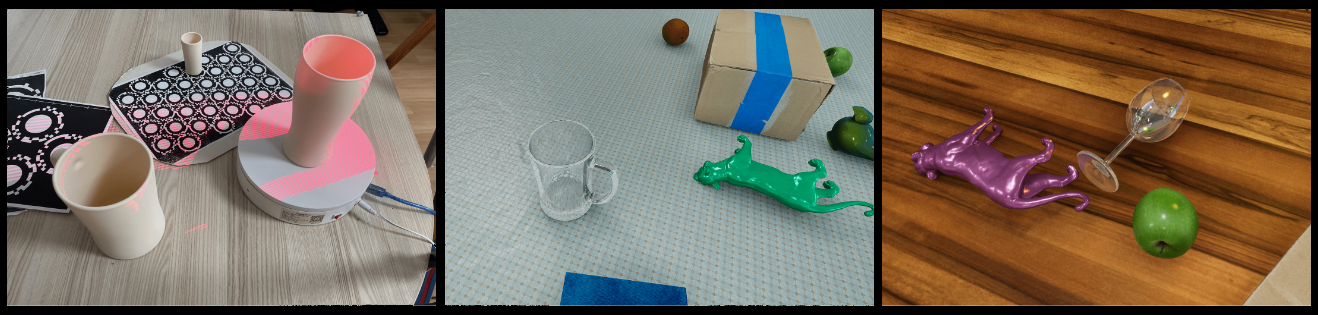
Collecting and labeling real-world 3D data is costly and time-consuming. We build custom synthetic data generation tools and digital twin pipelines that produce large, richly annotated datasets, enabling robust training of machine learning models without extensive physical data capture.
Process Simulation
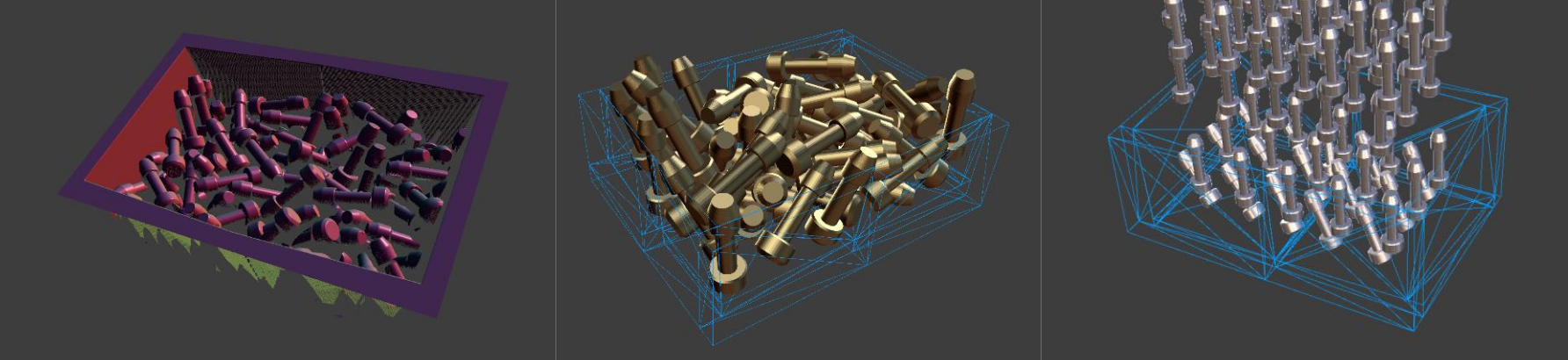
We simulate real industrial processes such as parts falling and settling into bins using physics-based simulation. These synthetic scenes closely mirror the conditions of real structured-light scanner captures, including scanner parameters, camera placement, and output format, making the generated data directly usable for training.
Parametric & Procedural Models
Our generators use parametric 3D models to produce high variety in synthetic scenes. By randomizing properties such as object size, shape, deformation, and surface material, we cover a wide distribution of real-world cases and reduce the sim-to-real gap for trained models.
Challenging Materials
Objects made from highly reflective or transparent materials such as glass are notoriously difficult to scan and detect. We generate synthetic training data for such objects using modern rendering frameworks and engines. For photo-realistic simulation of light caustics and transparency effects, we use renderers such as SuperCaustics1.